Overview
Summary
Exploring how Duolingo could enhance real-world speaking confidence for college students through community-based, AI-assisted practice.
Skills Learned
End-to-end product strategy, Metrics, MVP definition and prioritization, GTM strategy, Market sizing
Tools
Figma, Miro, v0, Figma MCP
Outline
- Introducing Duolingo Communities
- Business Case Analysis
- Project Overview
- Customer Needs & Persona Development
- Initial Hypotheses
- Phase 1: Discovery and Prioritization
- Phase 2: Prototyping and MVP Validation
- Product Roadmap and Launch Considerations
- Conclusion
Introduction
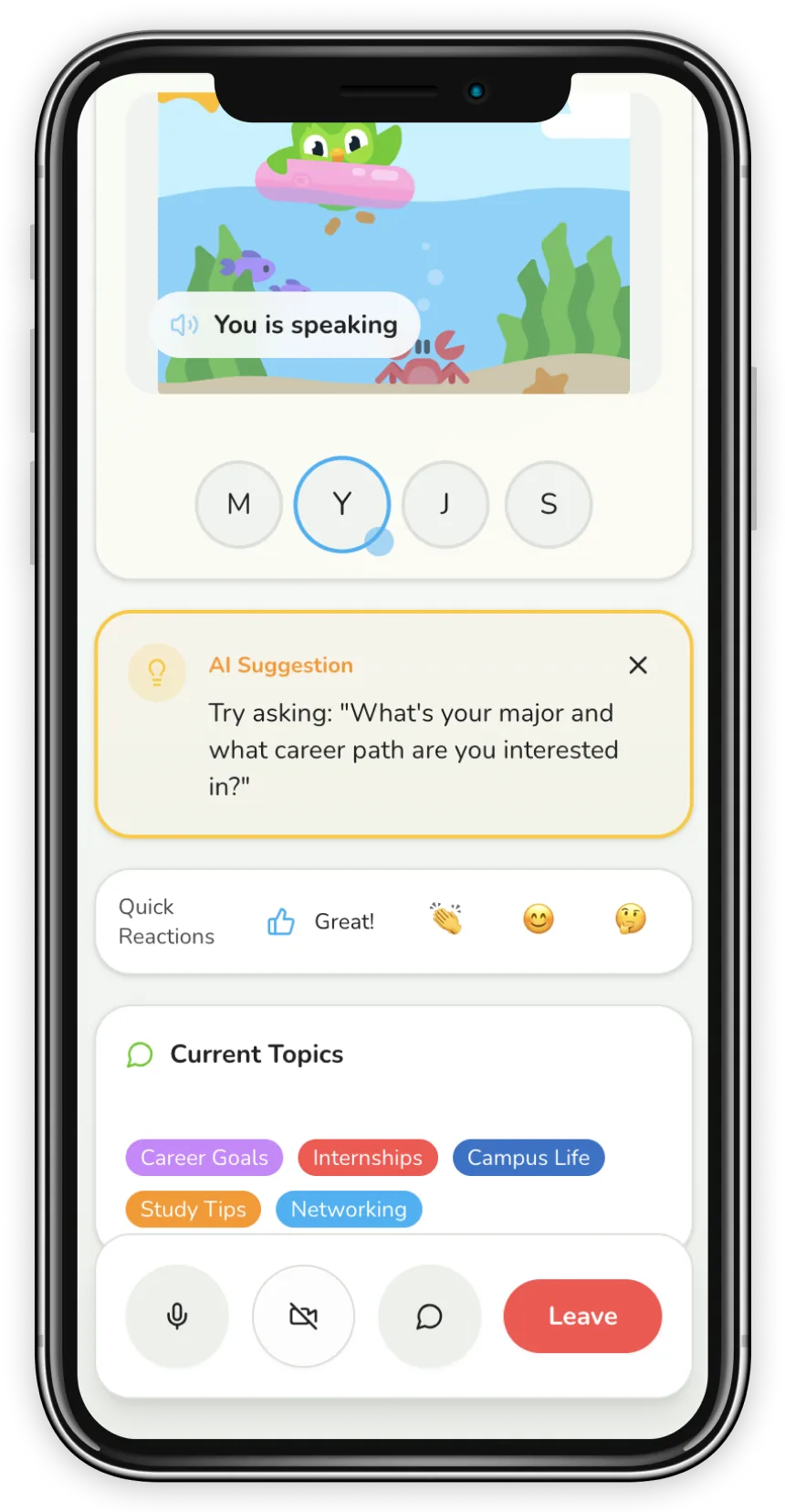
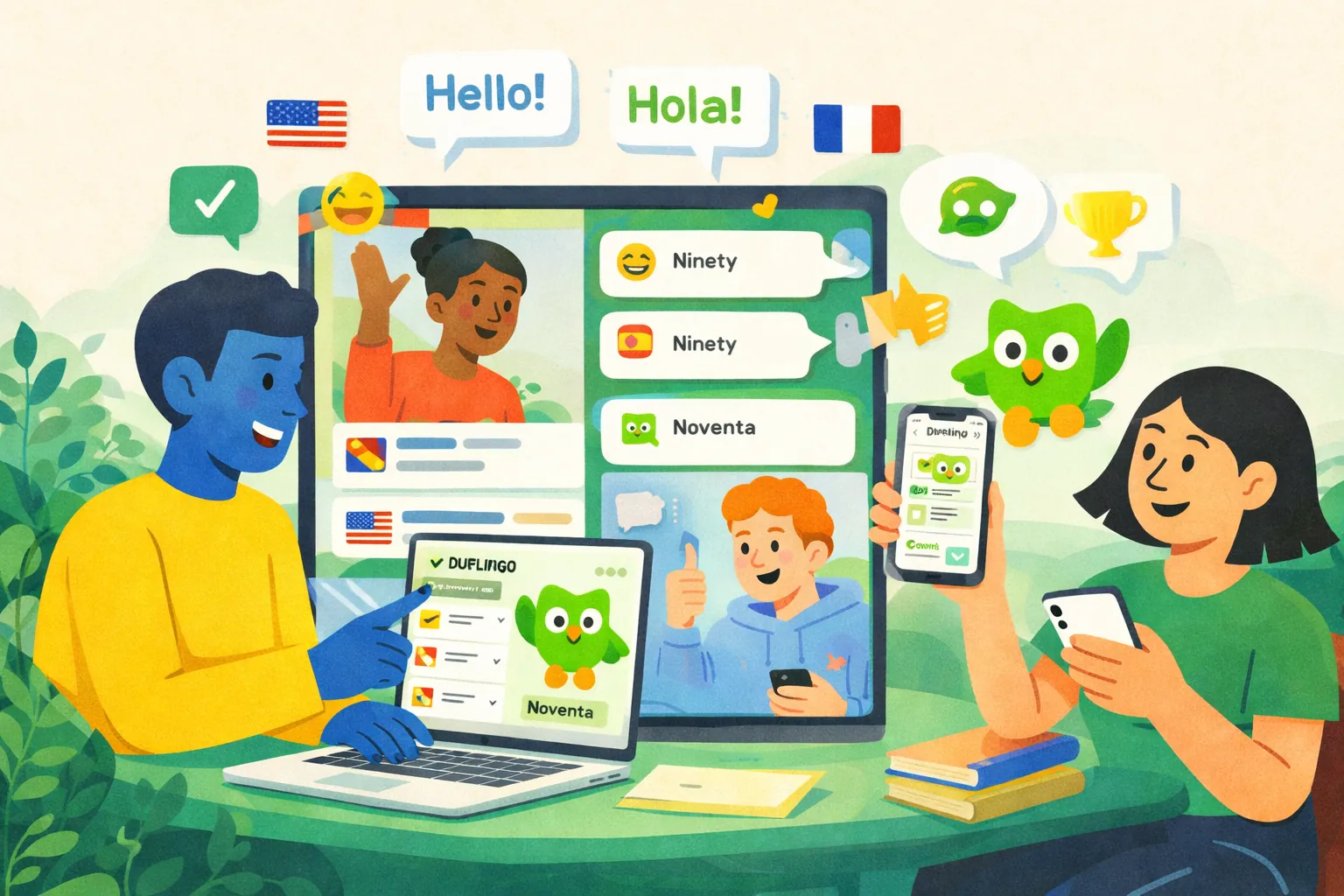
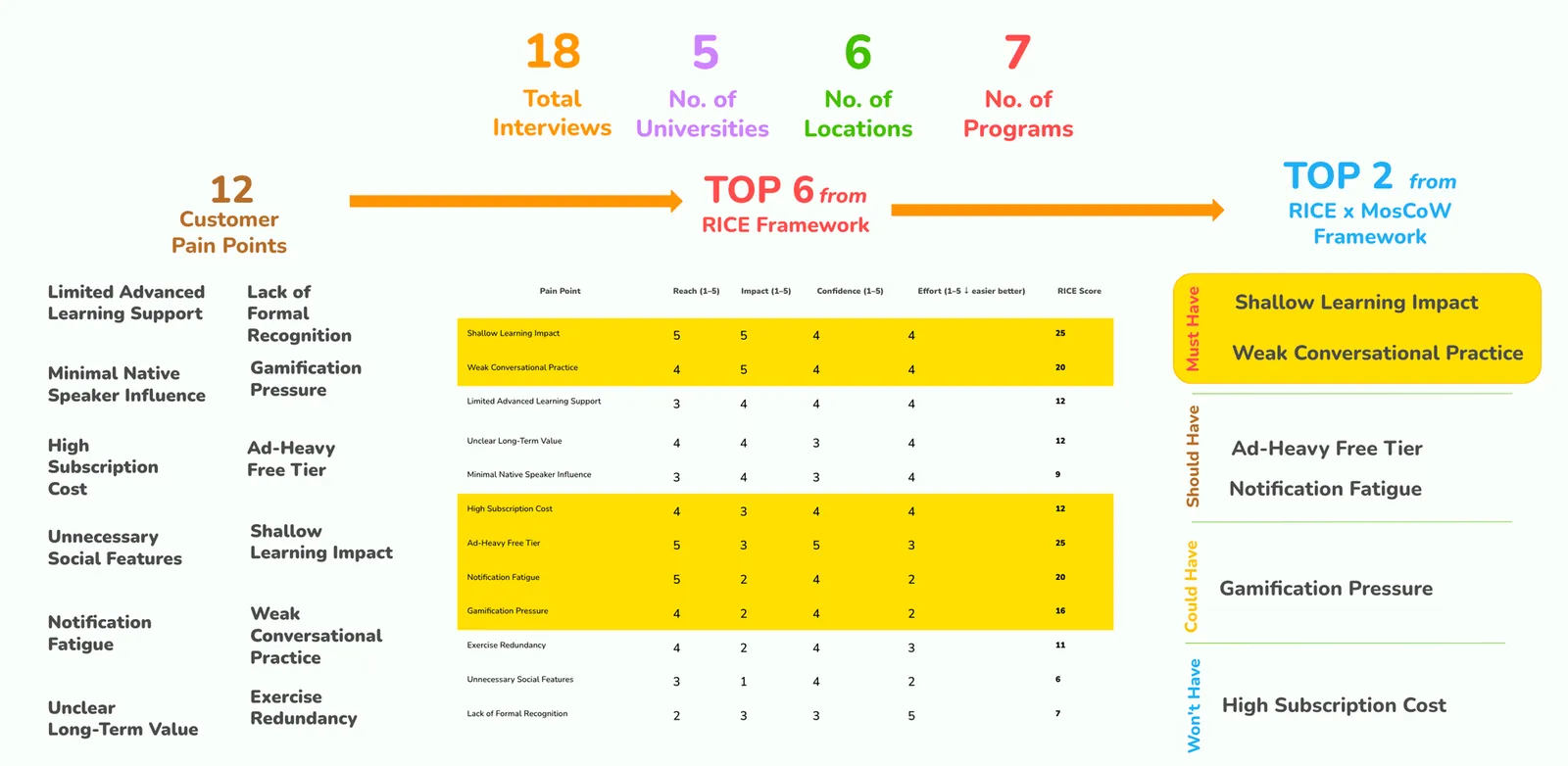
This project explored how Duolingo could address two key user pain points: weak conversational practice and shallow learning impact, identified through user interviews and prioritized using the RICE framework. We proposed Duolingo Communities, an AI-powered peer learning feature tailored for university students and young adults, matching learners by skill level and goals to enable short, guided conversation sessions with real-time feedback on fluency, pronunciation, and clarity. The goal was to bridge the gap between Duolingo’s gamified lessons and authentic speaking experiences, ultimately improving learner confidence, engagement, and retention.
Why Now?
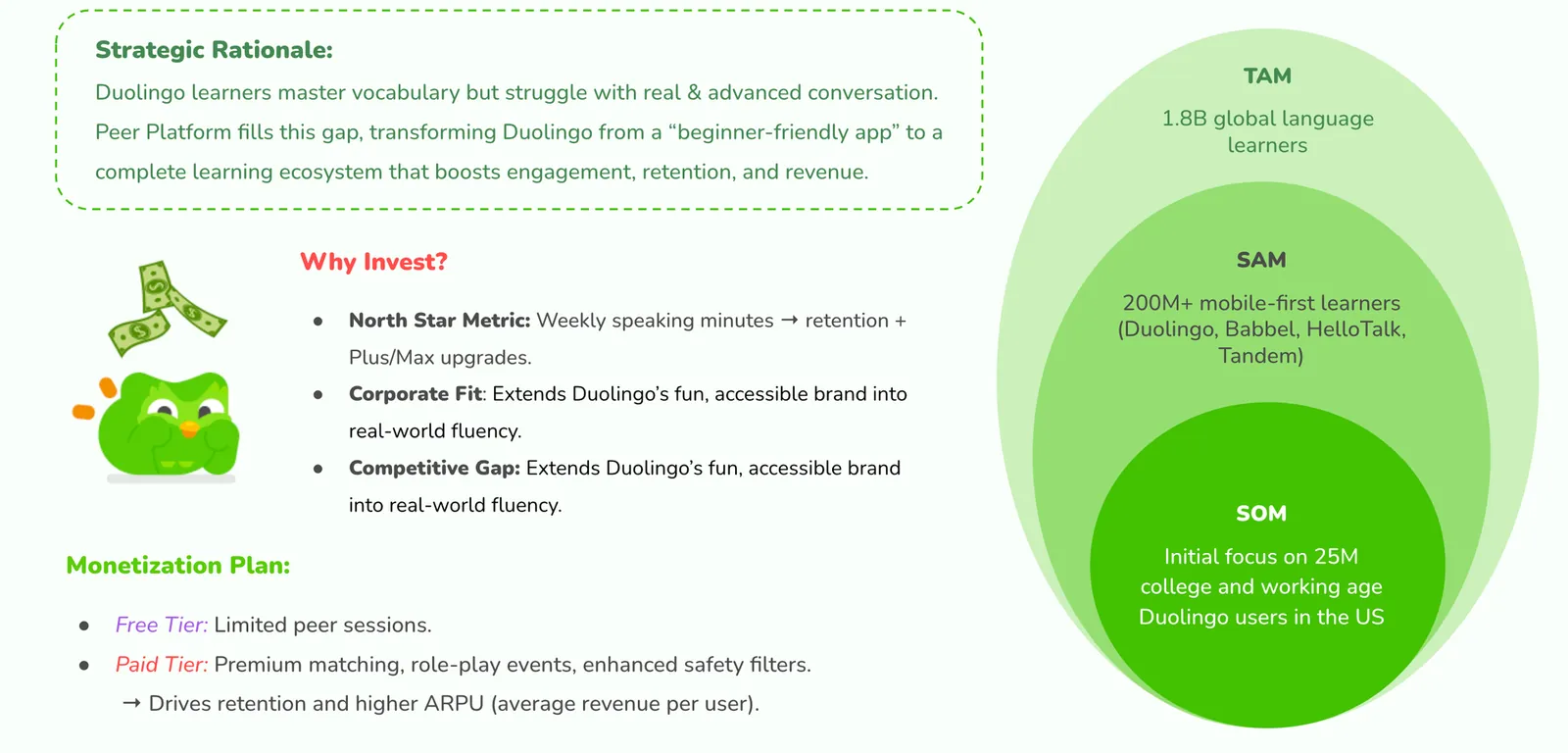
- Unmet Need: Users say Duolingo is “fun but limited for real conversations".
- Market Timing: $21B language learning market growing to $44B by 2030, driven by AI + community learning.
- Corporate Fit: Builds on Duolingo’s strengths – accessibility, gamification, personalization – to safely build speaking confidence.
MVP Focus
- Peer Matching: Match by proficiency, goals, and context (e.g., study abroad, career).
- AI Feedback: Real-time insights on pronunciation and fluency.
- 15-Minute Guided Sessions: AI prompts sustain conversation naturally..
Benefits
- Learners: Real conversation practice, confidence, and accountability.
- Duolingo: Higher retention → stronger premium conversion → new revenue streams.
Business Case
Project Overview
Project:
Duolingo Peer Platform – helping learners move from lessons to real-life conversations.
Why We Started:
Interviews showed high-streak students still feel unprepared for real conversations; retention drops after beginner stage.
Target Group:
University students (especially international/heritage + ADHD/neurodiverse).
Goal:
Increase speaking practice time, conversational fluency, and retention through peer practice + AI feedback.
Emily Chen
"I just want to make friends and work in this country—language is the first barrier."
Demographics:
- 24-year-old International grad student from China, non-native English speaker
- MSc in Computer Science at USC
- Studied English reading and writing since primary school but not confident in listening and speaking

Goal:
- Needs to strengthen academic and everyday English communication for seminars, group work, and daily life tasks.
- Needs flexible, on-the-go tools—primarily mobile, possibly offline—integrated into a packed academic schedule.
Use Cases:
- Micro-learning audio and speaking drills during gym sessions or transit.
- Roleplay simulations to practice small talk in study group contexts.
- Quick vocabulary/topic modules: e.g., academic phrases, idioms in everyday campus life.
- Confidence-building via “Explain My Answer” or feedback tools in Duolingo Max (if available).
Pain Points:
- Feeling socially isolated and anxious about casual academic conversations.
- Juggles coursework, teaching assistant duties, and job applications.
- Worries that her accent makes her sound less competent, leading her to stay quiet in discussions
- Feels uncomfortable at career fairs, office hours, or professional events where fast, informal English dominates

Jake Miller
Demographics:
- 20-year-old Sophomore @Studys Studio Art at NYU Lives off-campus, commuting by subway daily
- Tried to learn several languages since childhood but all failed halfway
Goal:
- Wants to turn unproductive commute time into meaningful learning.
- Aspires to improve language skills for travel, school, and connecting with global culture.
- Needs bite-sized, adaptive learning tasks that match his focus span.
- Seeks external accountability (reminders, gamified rewards, streak repair) to stay engaged.
Use Cases:
- Uses Duolingo on the subway ride to practice vocabulary and grammar.
- Intends to complete a 10–15 minute session per commute, but app usage is frequently interrupted.
- Switches to TikTok or social media mid-task because it offers quicker dopamine hits and less cognitive effort.
- Dreams of maintaining a daily streak but struggles with consistency.
Pain Points:
- ADHD-diagnosed, easily distracted by short-form entertainment (TikTok, notifications, subway noise). Values convenience, immediate stimulation, and flexible routines.
- Tasks feel too long or repetitive without enough novelty.
- Struggles with sustaining streaks—losing progress demotivates him further.
- Feels guilty for "wasting" commute time when intended to study.
Maya Thompson
Demographics:
- 19-year-old Comparative Literature student
- Lives on campus in the dorm
- Spends free time sketching anime, writing fanfiction, and engaging with global fandom communities online (K-pop, anime, Spanish cinema).

Goal:
- Wants to consume media in the original language without needing subtitles or translations.
- Aspires to create more authentic fanfiction/art with accurate cultural and linguistic references.
- Desires social validation and community recognition for her multilingual creativity.
Use Cases:
- Opens Duolingo specifically to learn vocabulary connected to creative hobbies.
- Shares progress and “cool words” with online fan communities to add authenticity to her creative output.
Pain Points:
- General vocab in Duolingo feels irrelevant—rarely tailored to fandom-related words.
- Gets frustrated when she can’t find niche terms (e.g., slang in K-pop lyrics or anime tropes)
- Feels isolated if learning progress isn’t connected to her creative community.
- Loses momentum when coursework becomes heavy.
Initial Hypotheses
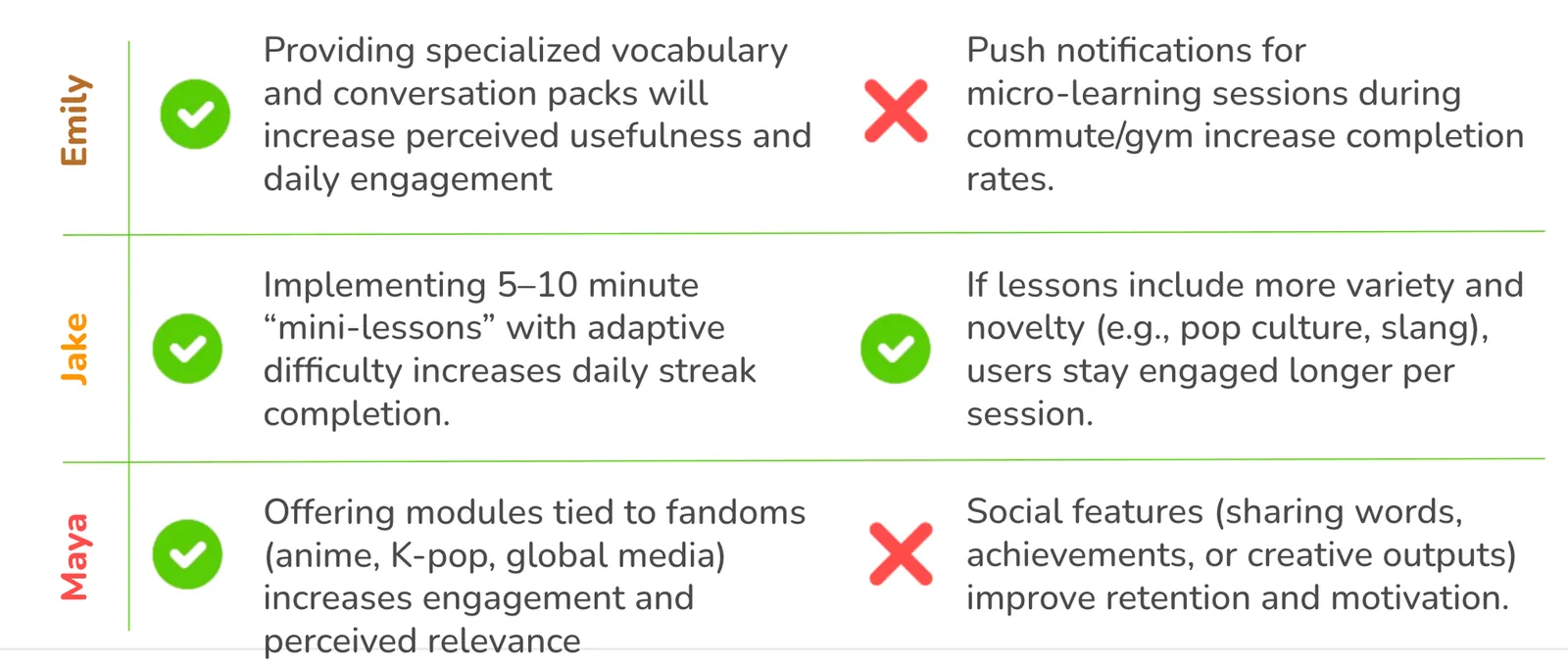
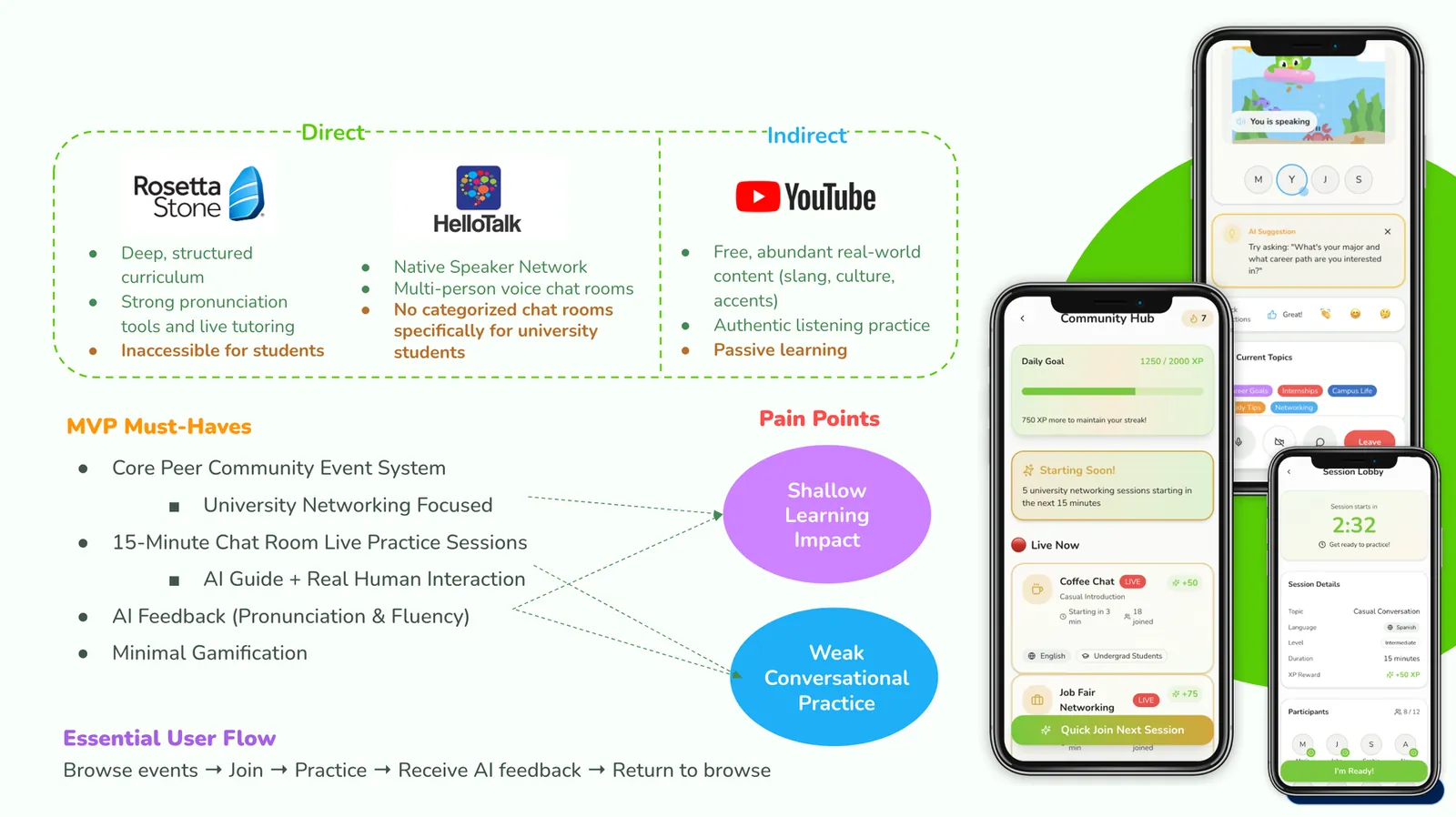
Validated via 12+ user interviews, pain point prioritization (RICE + MoSCoW), competitor analysis
- Students drop off after beginner stage because Duolingo lacks authentic speaking practice.
- Adding short peer practice events with AI feedback will improve confidence and retention.
- International and neurodiverse students will be earliest adopters of peer practice.
- 15-minute guided events can be delivered at scale without high cost.
Phase 1: Discovery and Prioritization
Hypotheses Validations
Phase 2: Competitor Analysis & Prototyping
Product Roadmap and Launch Considerations
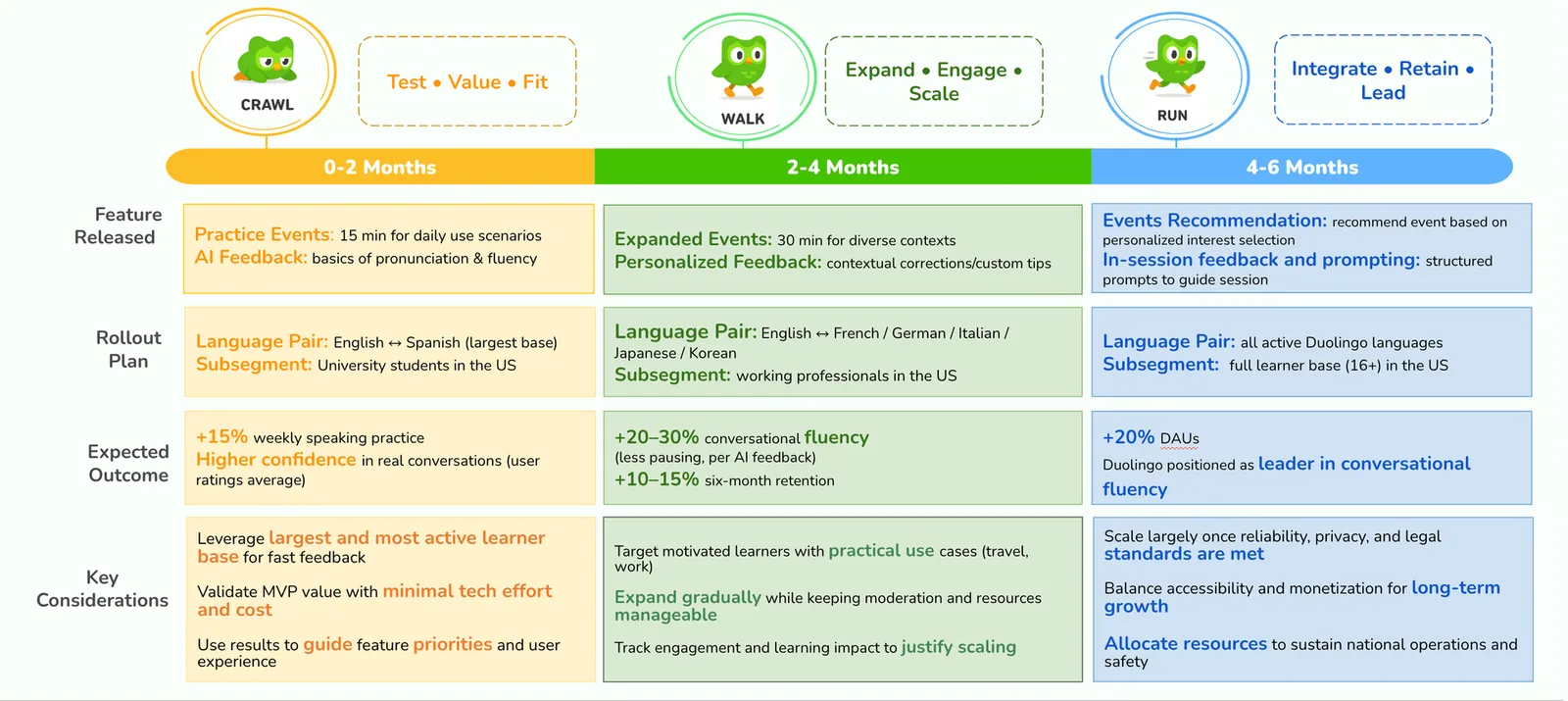
Market Window Fit:
- Timing: $21B → $44B by 2030 as AI and social learning drive growth.
- Advantage: Duolingo’s scale + voice data enable faster, feedback-driven conversation learning.
- Fit: Product Development — deepens engagement in existing market; Diversification — opens professional & academic use cases.
- Urgency: Demand for real conversation skills rising — ideal 6-month launch window.
Conclusion
Our team evolved through many ideas into a focused MVP for Duolingo Community Hub, a peer platform bridging the gap between gamified lessons and real conversation. Designed for university students, it helps intermediate learners (18–25) gain confidence through peer-led speaking practice and AI guided feedback.
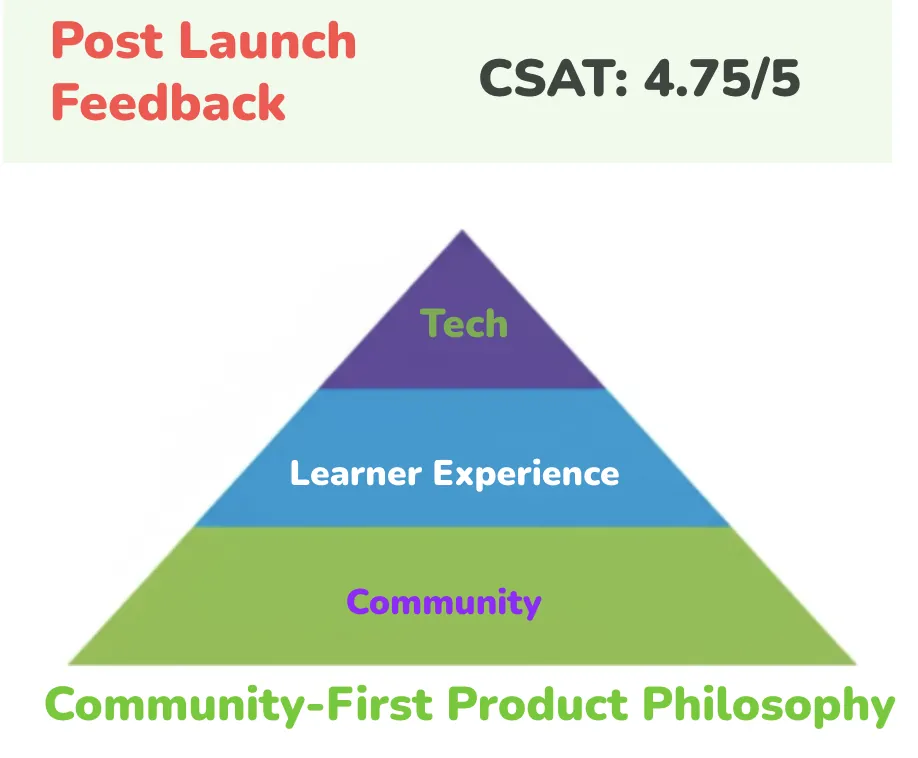
We learned that social interaction amplifies gamification and retention. Community isn't an add-on, it's a catalyst.
Key Takeaway
"Prioritization isn't just for features, it's how great teams manage ideas."
Prototype
Built using v0.dev