
Overview
Costco warehouses jam at peak hours across checkout, samples and returns. Members expect crowds; what frustrates them is not knowing how long they’ll wait.
It’s a timing problem, not a traffic problem: most members pick the same days and hours, even when their schedules are flexible.
Don’t speed up checkout; shift when members come. Invite the right member, at the right time, with the right sample, through the Costco app.
One of five on a team proposal. I contributed across every part: problem framing, persona, competitive analysis, market sizing, the breakeven model and the rollout plan.
This is a strategy proposal, not a shipped product. The persona is an assumed target user rather than an interview finding, and every number is a planning estimate.
The problem
Costco faces peak-time congestion across checkout, sample stations and returns. Waits are long and chaotic, especially at checkout: friction that adds nothing to the member experience.
How might we cut peak-hour wait times without forcing members to change their shopping habits, while preserving Costco’s treasure-hunt experience?
Constraints we held ourselves to
- No forced habit change: members should choose to move, not be made to.
- Keep the treasure hunt: the crowds and the discovery are part of why people love Costco.
- Stay low-cost: nothing that breaks Costco’s cost structure, such as extra staff or heavy hardware.
Target segment
Primary: time-pressed parents
Our target member is a busy parent, like a full-time doctor with young kids, who values efficiency, predictability and quality but still loves the treasure hunt. She shops at peak weekend hours, navigates a large cart through crowded aisles, and brings her family along for a shared outing. Any fix has to improve flow without taking away what makes the trip special for her kids.
Secondary: flexible solo shoppers
Members who shop alone and have some control over their schedule, but default to the weekend like everyone else.
Working hypotheses
- No motivation to change: members know it will be crowded and stick to the weekend anyway; the frustration is the uncertain wait, not the wait itself.
- Timing, not traffic: the issue isn’t how many people shop, it’s that they all pick the same days and hours.
- Certainty over randomness: members will move their trip if a clear benefit is communicated at a specific, predictable time.
The persona was assumed from the problem space, not drawn from interviews. These hypotheses are what the pilot has to prove first.
Positioning
We looked at how other big-box retailers handle the same problem:
| Competitor | What they do | Key move | Takeaway for Costco |
|---|---|---|---|
| Sam’s ClubDirect | Competes on price, bulk goods and membership value. | Scan & Go plus streamlined exit checks reduce the “line penalty.” | Members adopt faster flows if they feel optional, simple, and clearly save time. |
| BJ’sDirect | A smaller club focused on digital growth. | Buy online, pick up in club, and curbside let members skip congestion entirely. | A segment of shoppers prioritizes speed and certainty. |
| The Home DepotIndirect | A big-box retailer blending planning tools with in-store shopping. | Aisle location, inventory visibility and pickup reduce wasted time while keeping browsing. | Use digital to remove uncertainty while keeping browsing and discovery intact. |
Competitors reduce uncertainty, not shopping. That matches our core insight, and it set the positioning: turn “random friction” into “predictable, managed flow” without removing the crowd that makes Costco feel like Costco.
GTM strategy
Instead of speeding up checkout, the plan changes when members shop, using two things Costco already has: free samples and the Costco app.
Phase 1: Costco Taste Moment
Time-specific sampling notifications sent through the app nudge members toward quieter hours. The offer is a better sample, not a discount, so it costs little and adds to the treasure hunt instead of replacing it.
Sample premium imported cheeses from around the world. Deli section, 11:00 AM – 1:00 PM.
Phase 2: Costco Day promo incentives
Targeted promotions tied to specific time windows strengthen the shift and turn a one-off visit into a new habit.
Go-to-market at a glance
Members whose purchase history matches the item and whose visit history shows they can come off-peak.
Costco app push notifications, timed by member segment.
Phase 1: an exclusive tasting at a set time. Phase 2: a time-window promotion.
Corporate collaboration strategy
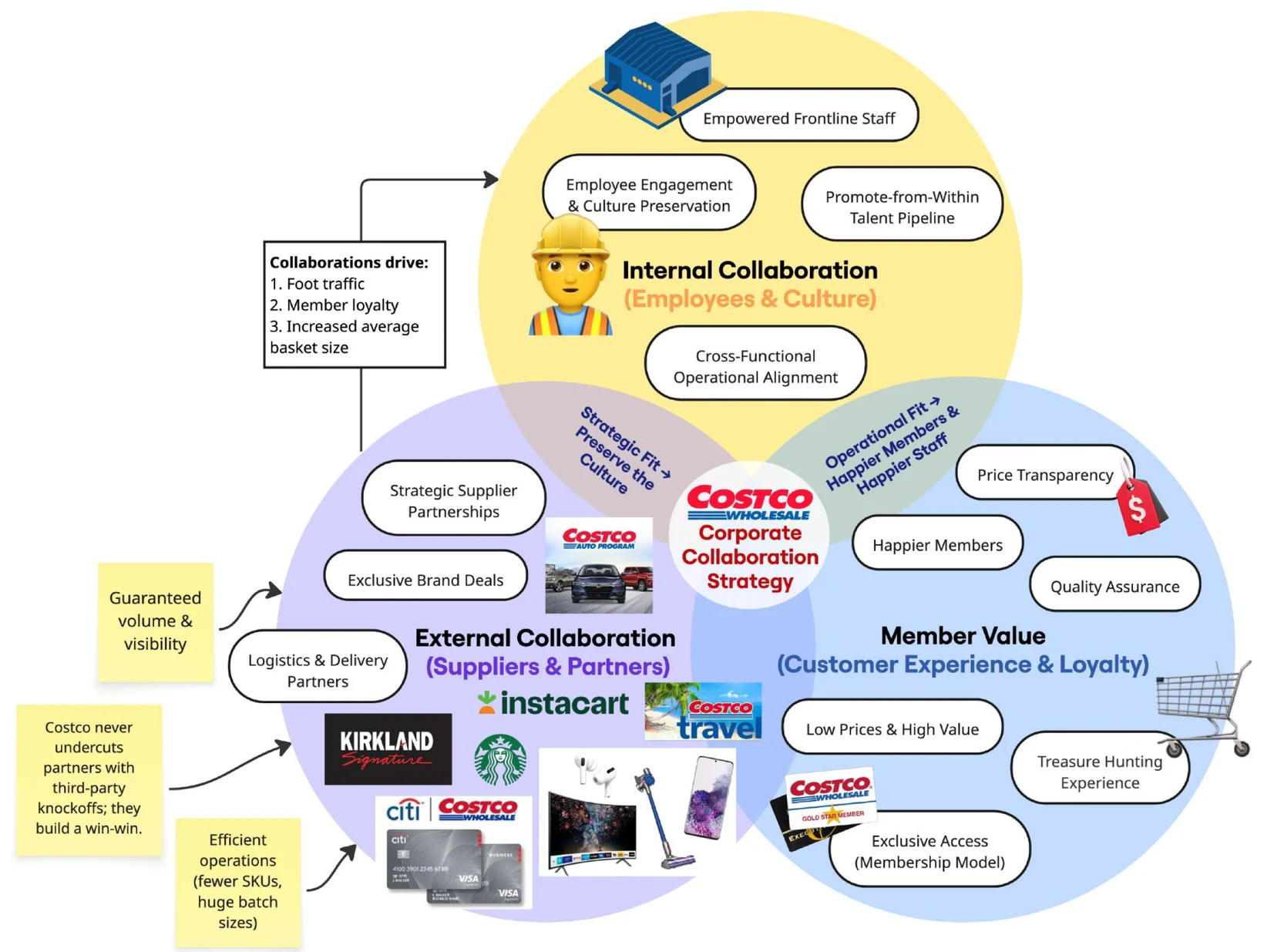
Costco’s model runs on three groups working together: employees and culture, suppliers and partners, and members. Collaboration among them drives foot traffic, member loyalty and a bigger average basket. Our solution strengthens this cycle by adding a shared data loop that improves coordination, partner ROI and member experience: suppliers get predictable traffic for their tastings, staff get smoother shifts, and members get shorter waits.
Market sizing
How we sized it
| Level | How we got there | Result |
|---|---|---|
| TAM | Annual U.S. in-store sales of the three warehouse clubs: Costco U.S. (≈ $180B) + Sam’s Club (≈ $90B) + BJ’s (≈ $20B). | ≈ $291B |
| SAM | Only Costco’s own warehouses and app can carry the solution, so the market narrows to Costco’s U.S. stores. (Costco has about 137M cardholders worldwide, most of them in the U.S.) | 614 warehouses, ≈ $180B |
| SOM | Pilot in the top 10% of warehouses by sales, where weekend congestion is worst: 614 × 10% ≈ 61 stores. At ≈ $180B ÷ 614 ≈ $300M in sales per warehouse, 61 stores carry about $18B a year. | 61 stores, ≈ $18B |
Figures are rounded estimates from public annual reports. The SOM uses average store sales, so it is conservative: the busiest stores sell more than average. Costco isn’t selling a new product here, so the SOM reads as revenue the pilot touches, not new revenue.
Business case
The solution earns money indirectly: through member retention and bigger baskets, plus operational efficiency. So the question is not “how much will it make” but “how little does it need to make to pay for itself?”
Impact = Δ membership profit + Δ merchandise margin − (fixed costs + variable costs)
| Assumption | Value |
|---|---|
| Fixed development cost | $500K |
| Variable cost per warehouse | $1,000 / year |
| U.S. warehouses (full rollout) | ≈ 600 |
| Total first-year cost | $1.1M |
| Merchandise gross margin | ≈ 11% |
| Incremental sales to cover $1.1M | ≈ $10M |
Pilot-scale check
The $46 assumes the cost is spread over all ~600 warehouses. In the 61-store pilot, the same $500K build plus $61K in running costs needs about $230 a day in extra sales per store. Against roughly $800K in daily sales at each of those stores, that is still under 0.03%.
Low-cost infrastructure; tech build (segmentation, prediction, backend, push); sampling planning; staff training.
Retention and lifetime value; membership-fee protection; basket-size lift; sampling conversion; operational efficiency.
Peak-traffic reduction; checkout wait time; push open → visit conversion; shopping-window shift; NPS; average transaction value.
Rollout & measurement
Roadmap for Q1 & Q2 2026
- 1Data re-discovery2025 digest · Algorithm development
- 2Campaign developmentMember segment · Notification timing
- 3Experiment planningMain focus: Phase 1 · Sub focus: Phase 2
- 4Pilot implementationStaff seminar · Discussion
- 5Rollout & optimizationWA – CA · West to east
- 6ForecastNPS · Retention
What we asked Costco for
- Access to the Costco app data API, to estimate cost and time to build.
- Past member segmentation data, to learn preferred items and shopping hours.
How the pilot is judged
- Primary: share of notified members’ visits that land in the target off-peak window, compared with stores that get no notifications.
- Outcome: peak-hour checkout wait time and peak-traffic reduction.
- Guardrails: average transaction value must not fall, notification opt-outs must stay low, and the tasting slot must not become a new peak.
- Go / no-go: roll out west to east only if the window shift holds without hurting basket size.
SWOT & Risks
SWOT analysis
- 93% member loyalty
- Rich shopping data
- Strong operations
- Proven influence tactics
- Limited physical space
- Fewer digital tools than competitors
- Habits are hard to change
- Must stay low-cost
- Increase member loyalty
- Spread out demand
- Better staffing efficiency
- Competitors innovating faster
- May lose busy shoppers
- Risk losing the treasure-hunt feel
Risks & mitigations
| Risk | Why it matters | Mitigation |
|---|---|---|
| Moving the peak | A popular tasting could create a new crowd at 11 AM on a Tuesday. | Cap invitations per time slot and spread tastings across departments and days. |
| Notification fatigue | Too many pushes and members switch notifications off for good. | Send only to members whose purchase history matches the item; track opt-out rate as a guardrail. |
| Habits are sticky | Weekend shoppers may like the idea and still come on Saturday. | Start with members whose history already shows weekday visits; Phase 2 adds a concrete incentive. |
| Losing the treasure hunt | Over-engineered flow could make Costco feel like any other store. | The lever is a better sample, not a queue or a booking system; the hunt stays. |
Reflection
- Validate the segment first: our persona was assumed. Before building, I’d interview members and read visit data to see who can actually move their trip.
- Size the pilot, not the chain: the first breakeven spread costs over 600 stores; the pilot-scale number is the one a decision-maker needs.
- Size the problem, not the industry: a $291B TAM says little about this proposal; revenue at stake during peak hours would say more.